Women’s economic vulnerability and agricultural labor
Tess of the d'UrbervillesWomen’s economic vulnerability and agricultural labor in Tess Durbeyfield’s story arise not from a single lack of income but from the way paid work, unpaid care, family obligations, and access to housing reinforce one another. Tess is expected to support younger siblings and her parents, take whatever agricultural employment is available, and endure conditions that leave her with scant power to refuse or recover. The novel places this pressure in specific settings: a bleak farm where women are hired cheaply, a rain-lashed field where stopping means losing wages, and a mechanized threshing floor where Tess’s labor must keep pace with a machine that does not pause for her.
Family Care and Economic Obligation
The pattern begins at home. Left with the younger children, Tess assumes a deputy-maternal role: the age gap between her and the next child is more than four years, and the two children who once filled that interval died in infancy. Her household contains six young dependants whom the narrator describes as unable to choose the conditions of their lives, entirely subject to their parents’ decisions. The image of the Durbeyfields as passengers compelled to travel wherever the adults steer makes household poverty more than an individual hardship: the consequences of poor provision are distributed among children who have no means of escape.
Tess’s own need to earn money is therefore bound up with the work of keeping a family alive. Her mother reproaches her for not having secured marriage to Alec as a means of helping the household, revealing how severely the family’s hopes have narrowed: marriage is imagined as a possible source of support, while Tess’s own experience of danger and coercion is pushed aside. Tess answers that she had been a child and had not been warned about men. The exchange shows that the family’s economic dependence does not simply press on Tess from outside; it shapes what her mother hopes she will obtain through a relationship, even as Tess bears the consequences of that relationship herself.
The same responsibilities persist during Tess’s separation from Angel. She has twenty-five pounds remaining from his allowance, but wet weather forces her to spend it. When her mother writes of urgent household repairs, Tess sends twenty pounds from the thirty due to her from Angel’s bankers. The money is needed for a leaking thatch, new rafters, and an upstairs ceiling, with the total cost, including an earlier unpaid bill, reaching twenty pounds. Tess then has to buy winter clothing and is left with only a nominal sum for the season. Though Angel had said she could apply to his father for further resources, shame and pride prevent her from admitting her need. Her allowance is thus not secure personal income: family demands, seasonal weather, and her reluctance to seek help quickly erode it.
Hiring, Low Wages, and Precarious Shelter
At Flintcomb-Ash, Tess’s entry into paid agricultural work is constrained by the scarcity and low valuation of women’s labor. She waits until the workfolk have received their wages before Marian introduces her to the farmer’s wife. The farmer is away, but his wife agrees to hire Tess if she stays until Old Lady-Day. The narrator observes that female field labor is seldom offered and that its cheapness makes it profitable for tasks women can perform as readily as men. Tess’s hiring is therefore both an opportunity and a sign of unequal bargaining power: employment gives her a roof for the winter, but only a poor subsistence and no evident margin for illness, lost work, or unexpected expense.
The farm’s setting intensifies that insecurity. Flintcomb-Ash is characterized as a place uncared for by its absentee owner, its landscape stripped of trees and green pasture and given over to fallow ground and turnips. The land’s barrenness is not merely scenery behind the labor: it defines a rural economy in which Tess must accept a place because she needs shelter and wages, while the available work is hard, exposed, and poorly rewarded. Her patience is described as a combination of moral courage and physical timidity, a quality that sustains her through conditions she has little power to change.
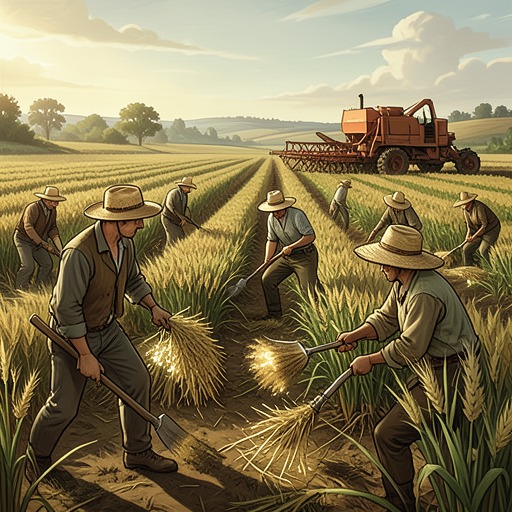
The turnip field makes the bodily terms of this employment visible. Tess and Marian hack a stretch of more than a hundred acres on the farm’s highest ground, using hooked tools to grub out the lower, earthy halves of roots after the livestock have eaten the tops and leaves. They crawl across a stony, exposed field in work clothes and sheepskin gloves, their movements mechanically regular. In the afternoon, rain races horizontally across the high ground in the wind. Although Marian suggests they could stop, not working would mean not being paid, so the women continue until the light fades, soaked through. The choice is stark: bodily endurance is the condition of earning even the day’s wages.
Their conversation returns them to Talbothays Dairy, remembered as green and generous in contrast to the drab field and hostile weather. Tess would rather not talk with Marian about the man who is legally, if not actually, her husband, yet the recollection draws her into speaking of that earlier life. The memory offers emotional relief, but it does not alter the material circumstances of their present labor. In the scene, the past’s fertility and the present’s exposure are set against each other while both women continue working because the wage depends on it.
Mechanized Labor and Unequal Control
At Flintcomb-Ash, mechanization changes the pace and distribution of field work without easing its demands on Tess. Farmer Groby assigns her a place on the threshing platform beside the man feeding the machine. Izz Huett passes the corn sheaves to Tess, whose job is to untie each one quickly enough for the feeder to spread it over the revolving drum. The threshing machine is itinerant, traveling from farm to farm, and its operator is separated from the agricultural workers by his specialized command of fire and steam. Tess, by contrast, is placed directly in the production line, her speed and stamina required to keep the mechanism supplied.
The work proceeds in long stretches. There is a half-hour stop for breakfast, but after the meal the farm’s supplementary labor is used to build the straw-rick while the thresher resumes. The workers eat a hasty lunch without leaving their positions. For Tess, the drum’s uninterrupted motion means there is no comparable pause: the feeder cannot stop, and she cannot stop supplying him with untied sheaves. Marian sometimes exchanges places with her for half an hour despite Groby’s objection that Marian is too slow-handed for feeding. Groby has selected Tess because, as he sees it, she combines strength, quickness, and staying power. These qualities enable her to keep the work going, but they also make her especially useful for a punishing duty with little respite.
The scene links technological change to the body rather than presenting machinery as an abstract improvement. Older men on the rising straw-rick recall threshing with flails on an oak barn floor, when the work was slower and, in their view, produced better results. The machine’s hum prevents ordinary conversation and grows more intense when the supply of corn falls short. At the end of the day the threshing gives way to rat-catching amid dogs, shouting, screams, and confusion; only after Tess has untied her last sheaf does the drum slow and cease. The sequence makes the machine’s demand tangible: work ends not when Tess is exhausted, but when the supply of sheaves and the operation itself are finished.
Labor, Displacement, and Social Judgment
Women’s economic insecurity is also bound to rural change and the loss of stable housing. In the account of village depopulation, the narrator describes a former class of artisans and small holders—people such as carpenters, smiths, shoemakers, and other workers—whose independent livelihoods had helped sustain village life. As long holdings fall in, their houses are often not let to similar tenants; they are demolished or taken for farm laborers. Families not directly employed on the land are treated unfavorably, and the departure of some impoverishes the trade of others, pushing more people toward larger towns. This wider change narrows the forms of work and residence available to families such as the Durbeyfields.
After John Durbeyfield dies, the household’s vulnerability becomes immediate. His death ends the last of the three lives on which the family’s lease depends. The tenant-farmer wants the cottage for regular laborers who lack accommodation, and leases of this kind are not renewed. The family’s former descent from the d’Urbervilles offers no protection: the narrator stresses the reversal by setting their ancestry beside their present status as landless people. Housing is not simply a private matter of rent or comfort; it depends on who controls land and whose labor the farming system chooses to house.
The eviction is further justified through moral judgment. The Durbeyfields’ ancestry is not credited, and the village has tacitly regarded them as a household that should leave, ostensibly in the interests of morality. The narrator notes the family’s drinking, the younger children’s rare attendance at church, and Tess’s sexual history, then exposes the punitive force of a demand that the village be kept pure. On the first Lady-Day when they can be expelled, their roomy house is required for a carter with a large family. Joan, Tess, 'Liza-Lu, Abraham, and the younger children must go. Economic displacement is thus presented not as an impersonal accident alone but as a decision filtered through class, labor demand, and social stigma.
The removal itself emphasizes the unequal treatment of women outside regular employment. Agricultural workers are commonly conveyed to their destinations in the vehicles of the farmers who need their labor; the early-morning movement of empty wagons and teams is organized around that employment. Tess and her mother receive no such assistance. They are women, not regular laborers, and not particularly required anywhere, so they must hire a wagon at their own expense. The difference between workers whose transport is arranged by an employer and a family that must pay to move its possessions condenses the larger pattern: women’s need for labor and shelter does not guarantee that either will be provided. Across domestic care, low-paid field work, mechanized production, and eviction, the novel shows how little security Tess can build from work when wages, housing, and family survival remain controlled by circumstances and institutions beyond her command.